
Every angler does the same thing before booking a trip: pull up the fish counts and look for the biggest number. I did it for years. It's also the single best way to talk yourself onto the wrong boat.
A fish count is not a scoreboard. "412 fish" tells you almost nothing on its own — not until you know how many anglers caught them, how long the trip was, and what kind of fish they were. Reading a count well is a skill, and once you have it, you stop chasing big totals and start finding boats that are genuinely on the bite.
Here's how to read a SoCal fish count the way the fleet does it, using real numbers from the boats working the water the week I'm writing this (late June 2026).
The total-fish trap
The total is the rookie number. It's the biggest, boldest figure on the dock report, and it's the one that lies to you the most, because it hides everything that actually matters.
This week the SoCal fleet reported roughly 61,300 fish over seven days. Sounds enormous — until you notice it took 10,600 anglers to catch them. A raw total only means something once you put it next to the number of rods that were in the water and the length of the trip that produced it. On its own, it's marketing, not information.
Fish per angler: the great equalizer
The number that actually matters is fish per angler — the total catch divided by how many people were aboard. It's the closest thing to an apples-to-apples measure of how the fishing actually was.
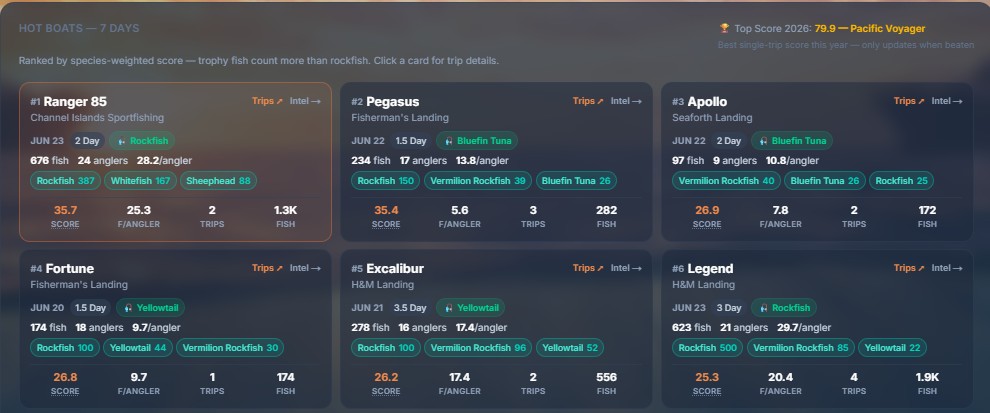
Here's how much that one division changes the story. On June 23, the Ranger 85 out of Channel Islands Sportfishing landed 676 fish with 24 anglers — that's just over 28 fish per angler, a genuinely loaded day. That same afternoon, several boats posted big, eye-catching totals in the 350–420 range. Impressive on the dock report. But they were carrying 55 to 64 anglers, which pencils out to about 6 or 7 fish per person. Same "big number" splashed across the count. A completely different day standing at the rail.
If you'd booked the boat with the gaudy total, you'd have fished a crowded rail for a fraction of the action. The boat that put up "fewer" fish was the one quietly fishing best. Total fish hid that. Fish per angler exposed it.
Not all fish are equal
A fish count flattens everything into one figure, but a 200-fish sack of sculpin is not the same trip as 26 bluefin tuna. There's a hierarchy, and good anglers read for it. At the top: bluefin and yellowfin tuna, yellowtail, white seabass — the trophy and premium gamefish people plan whole seasons around. At the bottom, doing the heavy lifting on most counts: rockfish, whitefish, sculpin, and perch. Bread-and-butter bottomfish that fill a cooler and make a great day, but aren't what you brag about for a year.
This week's board shows exactly why that distinction matters. The Ranger 85's 676-fish rockfish marathon scored 35.7 on our Hot Boats ranking. Right behind it, the Pegasus out of Fisherman's Landing scored 35.4 — on a trip that landed just 234 fish, barely a third of Ranger 85's haul. Essentially tied for the top of the fleet. How?
Because 26 of the Pegasus's fish were bluefin tuna. In a smart reading of a count, a bluefin is worth something like ten times a rockfish — so 26 bluefin very nearly cancel out 600-plus bottomfish. That's not a scoring quirk; it's the count telling you the truth. Both were outstanding trips. One was a wide-open rockfish grind, the other a premium offshore tuna run. The raw total would've told you the rockfish boat won by a mile. The species mix tells you they were dead even.
Zoom out to the whole week and it's stark: the fleet boxed about 29,000 rockfish and only 276 bluefin. Rockfish fill the counts. Bluefin make the trip. Read for which one you're actually after.
Recency: a count is a snapshot, not a forecast
A fish count describes a day that already happened. It is not a promise about the day you're booking.
Fish move — sometimes overnight. I learned that the hard way on a 2.5-day yellowtail run where the hottest kelp paddy we found at sunset was completely empty by dawn. A boat that absolutely crushed it ten days ago tells you very little about this Thursday. When you read a count, check the date first and weight the last few days the heaviest. A red-hot number from two weeks back is history, not a hot tip.
Trip type: compare like with like
You can't read a half-day count against a 3.5-day count and learn anything. They're built to produce different numbers. (If the trip-length ladder is fuzzy, I broke it all down in Half Day vs. Full Day vs. Overnight.)
This week the Excalibur out of H&M ran a 3.5-day and put up 278 fish at about 17 per angler, including 52 yellowtail. On a half-day boat, 17 fish per angler of quality fish would be a stellar morning. On a 3.5-day, it's a solid, respectable trip — but not extraordinary, because three and a half days at sea should produce more than a four-hour local run. Always ask what kind of trip generated the number before you judge it.
One more recency-and-intensity tell: when a boat posts 28 to 30 fish per angler — like the Ranger 85 and the Legend (29.7 per angler) both did this week — they're bumping right up against the California bag limit (20 fish per angler on the general limit, though it varies by species). On FYNC that trips a "BAG" tag on the card. It's about the clearest "this bite was wide open" signal you'll find in a count.
Letting the math do the work
That's a lot to juggle at the dock at 4 a.m. with a coffee in one hand. So we built all of it into the Hot Boats score on the Intel page, and it's worth understanding what's under the hood, because now you know exactly what it's doing for you.
Every trip gets a single score: species-weighted points per angler, with a recency decay so fresh trips count for more than old ones. A bluefin is worth roughly ten points, a yellowtail around eight, a rockfish about one, on down the line. That one number rolls together everything in this post — per-angler effort, species quality, and how recent the trip was — so the boat sitting at #1 is the one that genuinely fished best lately, not the one that stuffed the most rockfish onto the most anglers.
For a sense of scale: the best single-trip score of all of 2026 so far is 79.9, set by the Pacific Voyager. Most weeks the top of the board lives in the 25–40 range, which gives you a feel for what "hot right now" actually looks like.
Your 30-second pre-booking checklist
Before you put money down on any trip, run the count through five fast questions:
- Fish per angler, not total. Divide the catch by the anglers. Always.
- What species? Is the boat catching what you actually came for, or filling its count with bottomfish?
- How recent? Weight the last few days. Old counts are history.
- What trip type? Judge half-days against half-days, overnighters against overnighters.
- Check the score. Let the Hot Boats ranking and the Landing Bite table cross-check your read.
You can do every bit of this by hand off the raw dock totals — I did for years, and it works. Or you can pull up the Intel page, where every boat is already ranked by all five, click into the trips that match what you want to catch, and spend your energy on the part that actually matters: getting on the water.
The fish are biting. Read the count right, and you'll be on the right boat when they are.