
Ask anyone in a tackle shop what is biting in Southern California right now and you will hear about yellowfin. Maybe wahoo, if they have been reading the counts. Nobody is going to say bonito.
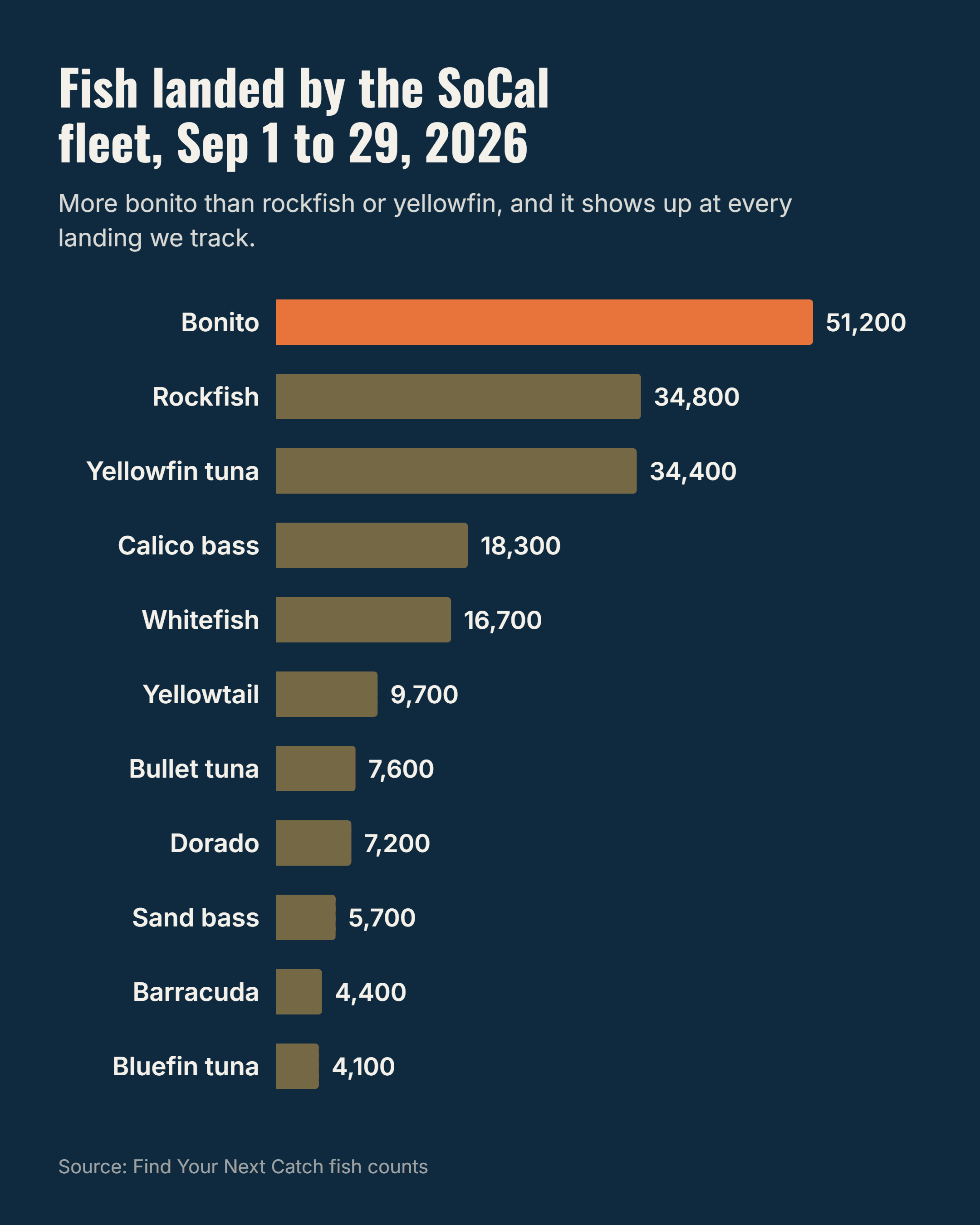
But from September 1 to 29, the SoCal sport fleet reported 51,200 bonito. That is more than rockfish at 34,800 and more than yellowfin at 34,400. It is the single most-landed fish in the region, and it is not close.
It also showed up on more landing-days than anything else we track, at every one of the 19 landings reporting to us. There is a fish that is more available to more anglers on more days than any other in Southern California, and it is the one fish almost nobody plans a trip around.
The breadth number is the real story
Total fish is the headline, but it is not the interesting part. One good week on a school of anything can move a total.
The number I would point at is landing-days: how many separate landing-and-day combinations reported that species at all. It measures how widely a fish is spread across the fleet rather than how many happened to pile up on one boat.
| Species | Fish, Sep 1 to 29 | Landing-days |
|---|---|---|
| Bonito | 51,200 | 381 |
| Yellowtail | 9,700 | 346 |
| Calico bass | 18,300 | 320 |
| Sand bass | 5,700 | 244 |
| Sheephead | 1,800 | 244 |
| Rockfish | 34,800 | 228 |
| Whitefish | 16,700 | 212 |
| Yellowfin tuna | 34,400 | 188 |
| Dorado | 7,200 | 167 |
| Bluefin tuna | 4,100 | 57 |
Plot those two numbers against each other and bonito sits alone in the corner.
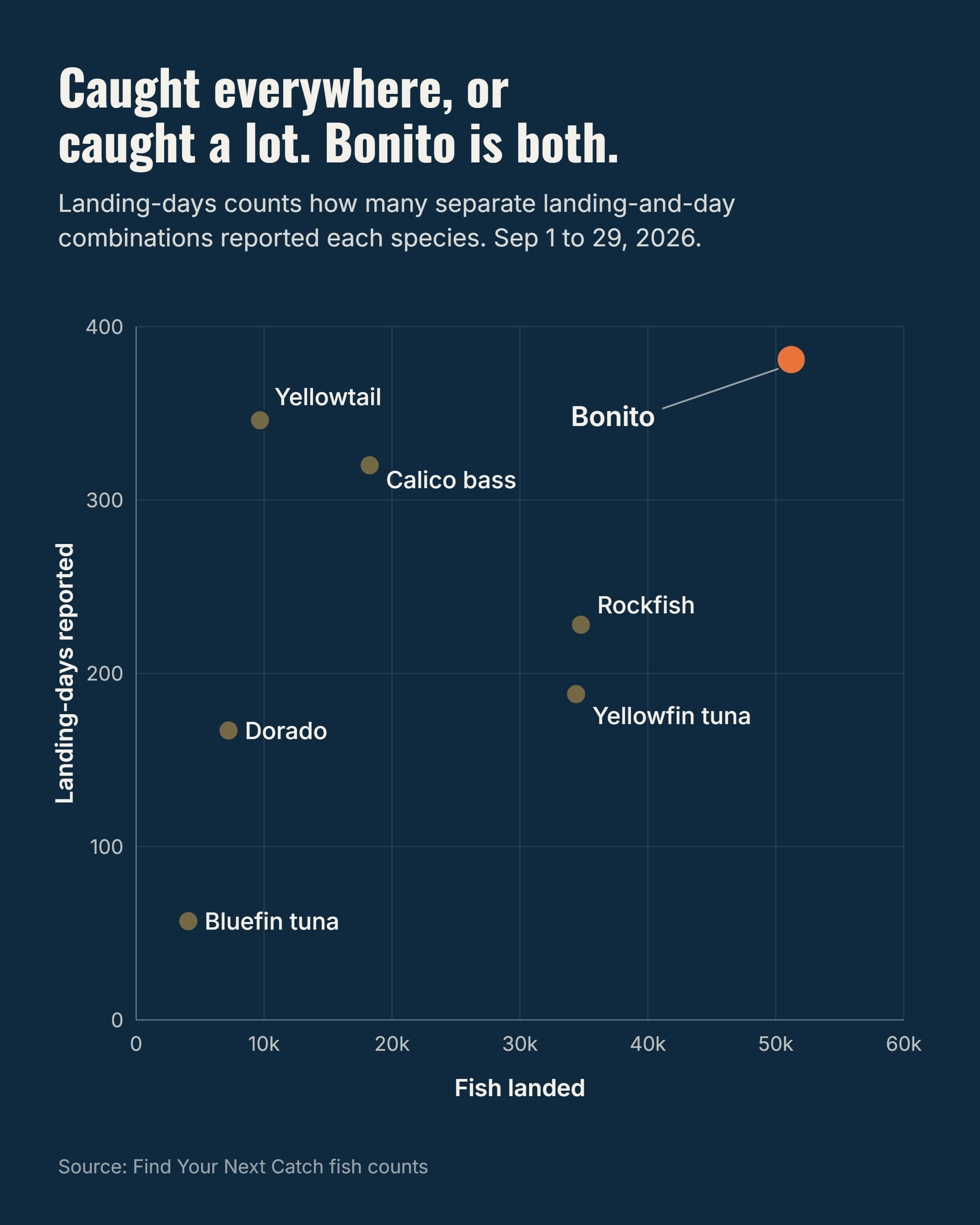
Yellowtail is spread wide but thin. Yellowfin is heavy but narrower, reported at 15 landings rather than all 19. Bluefin, the fish that got the most attention all summer, appeared on 57 landing-days, roughly one seventh of bonito's reach.
If you picked a random SoCal boat on a random day this month, the fish you were most likely to see come over the rail was a bonito.
You can check this yourself. Filter the species cut to bonito at findyournextcatch.com/intel and every landing we track shows up.
A number I almost wrote a headline off
Our species page reports catch per angler alongside each species. When I first pulled it for this piece, it showed bonito at 1.30 and yellowfin at 1.29.
That looked like a story. Cheapest trip on the board, best catch rate in the region.
I pulled it again a few days later over a fixed window, September 1 to 29, and it had flipped: bonito 1.27, yellowfin 1.32.
Nothing happened to the fish in those few days. What changed was the window. A number whose ranking reverses when you slide the dates a little is not telling you which fish is easier to catch, and I would rather show you that than quietly publish whichever version supported the headline.
It is worth understanding why the number is softer than it looks. Catch per angler here is species-specific and counted by landing-day. It adds up every angler at every landing that reported that species on that day, then divides the species total by it. A landing that sent out one bonito boat and three rockfish boats contributes all four boats' anglers to the bonito denominator.
So it is not a comparison of one trip against another, and it never was. An angler on a yellowfin trip is usually also catching skipjack, dorado, bullet tuna and yellowtail on the same run, none of which appears in that 1.32.
The volume and the reach numbers hold up. Bonito is the most-landed fish in the region and it is reported at all 19 landings while yellowfin is reported at 15. Those are counts of things that happened. The per-angler rate is a ratio built on a denominator that does not mean what a casual reader would assume, and I am not going to build an argument on it.
So what is bonito actually good for
Availability, and nothing else in the region comes close.
Bonito are small. A typical SoCal bonito runs a few pounds, against a yellowfin that might be anywhere from ten to sixty-five. Nobody is filling a cooler the way they would offshore, and nobody is putting one on the wall.
What they are is reliable, aggressive, and reachable on the cheapest ticket at the landing. They fight harder than their size suggests, they hit fast, and they are on grounds a half-day boat can reach quickly.
That makes bonito the right answer to a specific question, and it is a question we get asked constantly.
If you are taking a kid out for the first time, what matters is a bent rod, not a trophy. A half-day boat into bonito will produce more hookups per hour than almost anything else available right now. An overnight that finds no tuna produces a very long, very quiet ride home for a nine year old.
If you have never been on a party boat, bonito trips are where you learn the mechanics. Where to stand, how to follow a fish around the rail, what the deckhands are yelling about. Learning that on a hundred-dollar half day beats learning it on a four-hundred-dollar overnight. If that is you, start with our guide to your first charter and our breakdown of trip lengths.
If you have one free morning and you want to catch something, the counts say this is your highest-probability trip. Not your biggest fish. Your highest probability.
Half-day trips running this week are at findyournextcatch.com/trips, and they are the cheapest tickets on the board.
The part nobody tells you
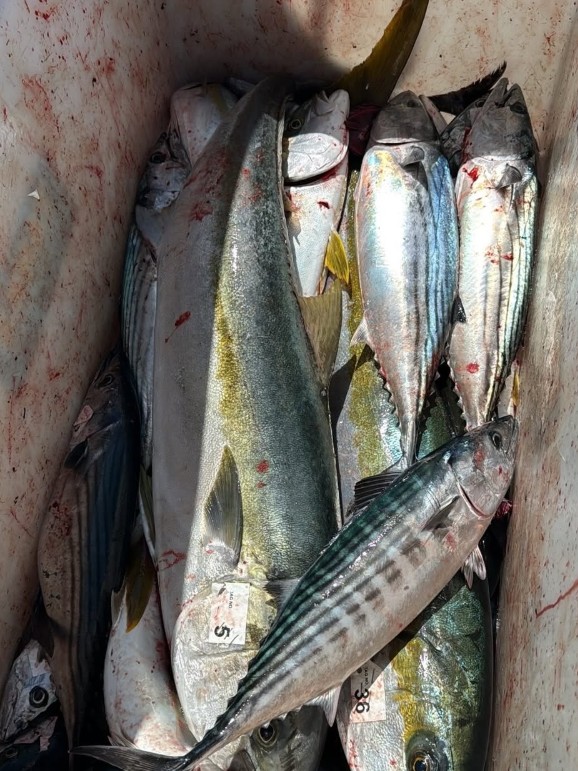
Bonito, calico bass and yellowtail from a Freedom overnight, August 7. Photo courtesy of Freedom Sportfishing and 22nd Street Landing.
Bonito have a reputation problem. Ask a regular and you will hear they are a nuisance fish that cuts you off, tears up a bait tank, and shows up when the good stuff is not around. Ask about eating one and you will hear worse.
I think that second part is wrong, and I will say so plainly: bonito is a good fish to eat. It just punishes you harder than almost anything else for handling it badly.
Bonito is a tuna, not a bass. The flesh is dark red and oily, much closer to bluefin than to a halibut or a calico. That is also why it turns on you so fast. A bonito that sits out warm goes a little mushy, and that is the bonito most people have tasted. Then they tell everyone bonito is trash.
The fix is to bleed them and get them on ice immediately, and the good news for anyone booking a half day is that most boats already do exactly that. The deckhands are not guessing at this. Hand them your fish and it gets handled.
If you are cleaning them yourself, cut the dark bloodline strip out before you cook. That strip is where the strong flavor lives.
Done right it grills like a light tuna, it smokes well, it makes a good ceviche or poke if it is same-day fresh, and it cans better than most people would believe.
Worth knowing that a lot of the "bonito is garbage" talk online is not even about this fish. On the Gulf and Atlantic coasts "bonita" usually means little tunny or false albacore, which is a genuinely strong-flavored fish. Pacific bonito is a different animal with a different reputation among the people who actually keep them.
None of which makes a bonito a yellowfin. But a fish being unglamorous to a veteran does not make it a bad trip for someone who has never caught anything on the ocean, and it does not make it bad on the grill either. The counts say the fleet has been catching an enormous number of them all month while the coverage, including ours, has been pointed offshore.
The most available fish in Southern California deserves better than being the thing you complain about while waiting for something else.
Watch it yourself
Every number in this post came from our own fish counts, pulled nightly from SoCal landings and joined to the trips actually running. Sort by species, region and time window at findyournextcatch.com/intel, and find this week's half days at /trips.
Sort by species, pick bonito, and look at how many landings show up. It is all of them.