Three calls for October, then what I think happens in November.
Rockfish, all month. It has the highest catch rate in the fleet right now and the fleet is still moving inshore. This is the book if you want fish in the cooler.
Yellowfin, in the next two to three weeks. The bite is still good. I expect it to thin rather than stop, but I would not be waiting until November.
Not dorado, not billfish, and not yet bluefin. Dorado and the billfish are gone. Bluefin I think comes back, but not in time for an October booking.
And before any of that: there is a tropical storm pointed at us this weekend.
This weekend first
Tropical Storm Rachel is forecast to approach northern Baja California and reach Southern California over the weekend, with long-period southerly swell building ahead of it. The National Hurricane Center is advising Southern California to monitor it.
If you have something booked Saturday or Sunday, call your landing. Do not assume. Boats cancel on swell and landings will tell you straight.
This is the fourth tropical system to reach our water in about five weeks, after Marie over Labor Day weekend and Odalys and Polo in late September. That pattern is the thread running through the rest of this forecast.
Call one: rockfish, and I am confident about it
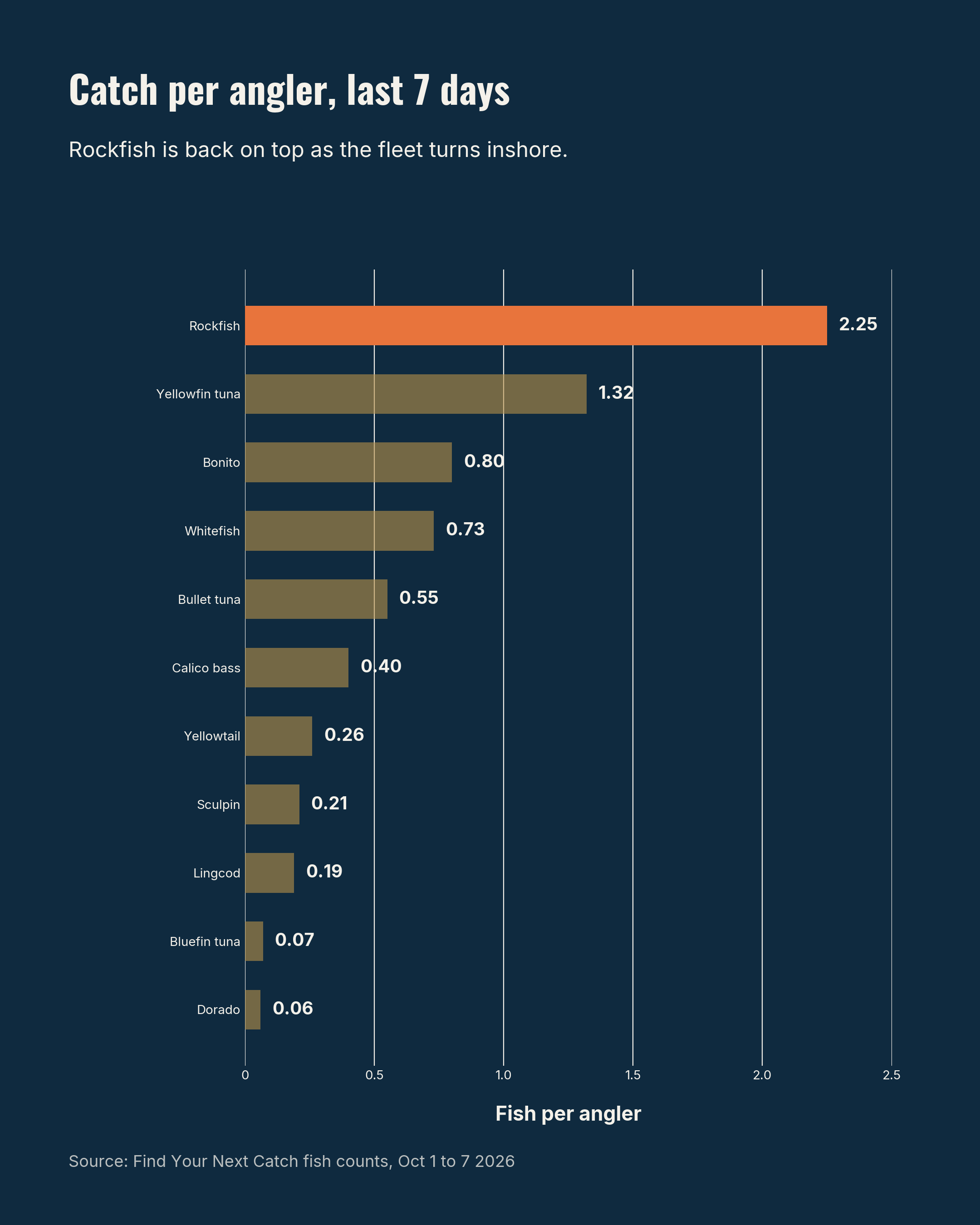
Over the last seven days, October 1 to 7, the fleet landed 7,500 rockfish at 2.25 per angler, the highest rate of any species in Southern California, ahead of yellowfin at 1.32. Rockfish is the better rate, but yellowfin is still the bigger number: 8,500 fish to rockfish's 7,500.
Rockfish led the rate board in spring, tuna took it through the summer, and it has just come back. It has gone from 1.34 per angler over the last 30 days to 2.25 over the last week. The fall pivot is on, and I expect it to strengthen through October as the water cools and the fleet commits to the bottom. Whitefish at 5,100 and lingcod running about a quarter higher than its 30-day rate both point the same direction.
What I expect: rockfish stays the top rate in the fleet for the rest of the month, and the Channel Islands, Ventura and Central Coast boats keep producing the best of it.
What would prove me wrong: rockfish falling below 1.8 per angler, or yellowfin retaking the top rate for more than a week.
One caveat worth your own research: California groundfish regulations change by area and season, and depth and species restrictions move. Check CDFW before booking rather than taking my word for the season being open where you fish.
Call two: yellowfin, but do not wait
Yellowfin is still the best offshore story we have. 8,500 fish last week at 1.32 per angler, and 40,900 over the last 30 days. It was running 1.53 across the 14-day window, so it has eased without breaking.
What I expect: a gradual fade rather than the cliff bluefin went off. Yellowfin has been the most durable fish of the back half of this season and the water is still warm enough to hold it. But the trend is down, not up, and every week from here is a worse week than the one before.
What would prove me wrong: yellowfin still above 1.0 per angler at the end of October. If that happens, the window was wider than I called it and I will say so in November.
My advice: if you want a tuna trip in 2026, book it in the next two to three weeks, out of San Diego or Orange County.
Call three: what I would not book
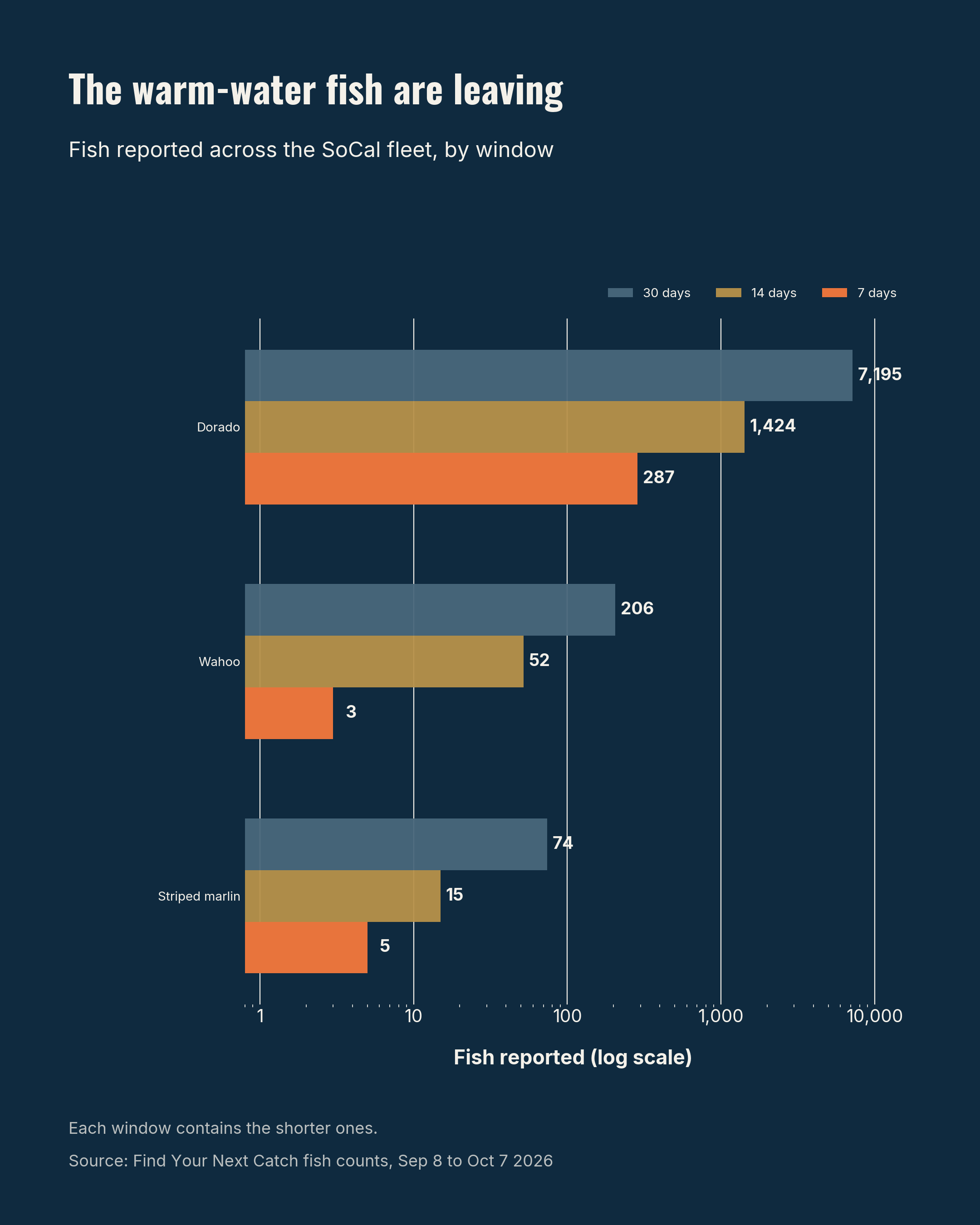
Dorado. 7,200 fish over 30 days, 1,400 over 14, and 287 last week. Its catch rate has fallen from 0.30 per angler over the month to 0.06 last week, an 80 percent drop. That is a species moving out, not a bite going quiet.
Billfish and wahoo. September's tropical run is finished. Three wahoo and five striped marlin last week, against 206 and 74 over the month. The blue marlin, the spearfish and the monchong that turned up in mid-September are gone.
Bluefin, for now. 178 fish across the whole fleet last week. I called a bluefin recovery for October in the September forecast and it did not happen, so take this with that in mind: I think they come back.
Bluefin are a cooler-water fish than yellowfin. If the swell scattered them rather than the water pushing them out, there is no reason they stay gone once things settle. But the water has not started cooling yet and the counts have not moved. I would not book an October trip on it. I would watch the counts and be ready to.
Why the fish are leaving while the water stays warm
This is the part I had wrong, and it shapes what I expect next.
I assumed the warm water had receded. It has not.
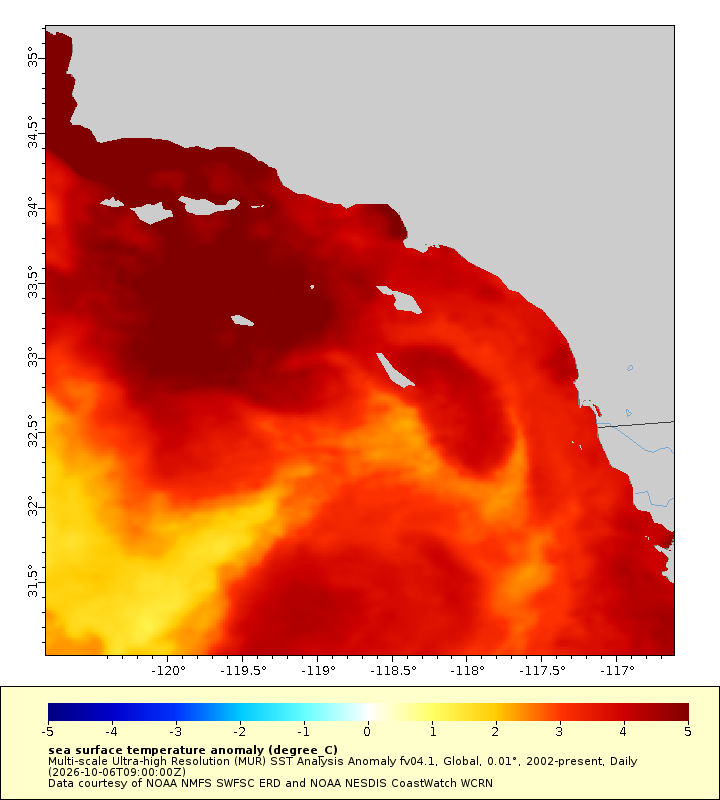
Sea surface temperature anomaly, October 6, 2026. Source: NOAA CoastWatch / NOAA NMFS SWFSC ERD, MUR SST Analysis Anomaly v4.1.
On September 18 the warm core sat in the Santa Barbara Channel. Three weeks later nearly the whole Bight reads four to five degrees above normal and the cooler offshore water has been pushed out. The ocean is warmer than it was when the dorado were here.
What I left out of the September forecast was the swell. Hurricane Marie put ten to twelve foot long-period surf into Southern California over Labor Day weekend, closing beaches and breaching a seawall in Long Beach, with the worst of it September 5 to 8. Odalys and Polo followed in late September. Rachel makes four.
Dorado do not relate to a temperature reading. They hold under kelp paddies and follow bait, and a run of long-period swell breaks paddies apart and scatters what is under them. That fits what the counts show better than temperature does.
I cannot prove it from counts and I am not going to pretend otherwise. But the timing is hard to ignore, and it is the reason my forecast for the rest of the year has changed.
What I expect in November
Bluefin returns as the water cools. This is the call I most want to be right about and the one I am least able to prove. The Bight is still four to five degrees above normal, so the cooling has not started. When it does I expect bluefin back in the counts, and I would not be surprised to see them before yellowfin leaves. Last year they held into November.
What would prove me wrong: bluefin still under 500 fish a week at the end of November.
Rockfish keeps improving. Cooling water, a committed fleet, and the species that has already taken the top rate. This is the easiest call on the board.
Yellowfin fades but does not vanish. If the water stays this warm I would not be surprised to see scattered yellowfin into November, well past where last year's season ended. Thin, but there.
More swell, and it matters more than the thermometer. Forecasters are now describing a strengthening El Niño driving this run of eastern Pacific storms. If that holds, expect more southerly swell events through late October and November. On this season's evidence, swell has moved fish more than temperature has.
A season that does not look like last year's. I built the September forecast on last October's pattern and it failed. I am not doing that again. The water is warmer, the storms are more frequent, and I would treat last year's calendar as a weak guide at best.
How to check me
Every number here came from our own fish counts, pulled nightly from SoCal landings and joined to the trips actually running. You can see the same data I used at findyournextcatch.com/intel, filter by species, region and window, and judge the calls yourself.
Trips running this week are at /trips.
I will be back at the start of November with what the month actually did, including the parts I got wrong.