Everything ran early this year.
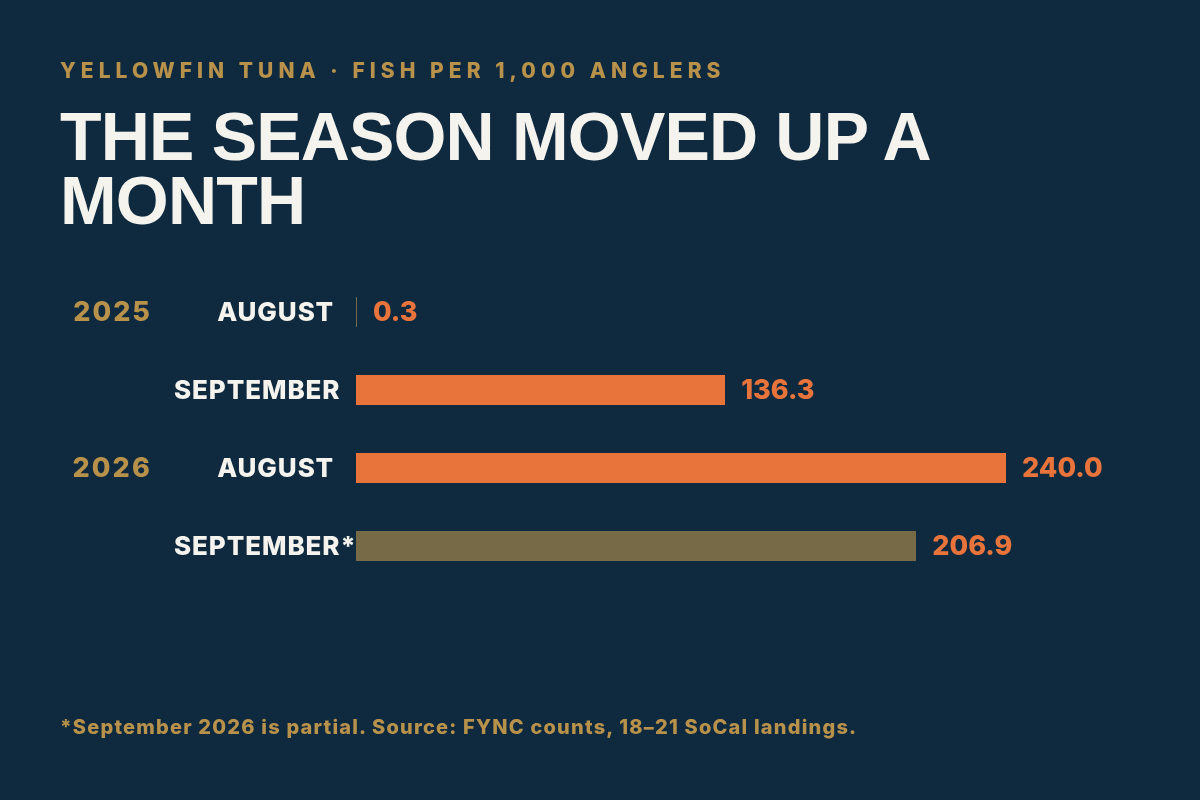
Last September, yellowfin arrived off Southern California like a switch had been flipped — our counts went from a rounding error in August to more than 4,400 fish in September. This year they didn't wait. August was the yellowfin month, and September is running slightly behind it. Dorado did the same thing: a September story in 2025, an August story in 2026.
Ask around the docks and you'll hear one word for why: El Niño. That's the obvious answer, and according to NOAA, it's the wrong one — at least so far.
El Niño hasn't actually gotten here yet
NOAA Fisheries published a piece on September 3 laying this out, and it's worth understanding because it changes what you should expect for the rest of the season.
The ocean off Southern California is unusually warm. But NOAA is explicit that the warmth comes from a marine heatwave that predates the current El Niño, and that much of the Pacific Coast is still awaiting El Niño's actual impacts. El Niño was declared back in June — but that declaration is based on water temperature in the tropical Pacific near the equator, which warms months ahead of anything happening off our coast.
The mechanism is slow. Weakening equatorial winds set off oceanic Kelvin waves that travel east, hit Central and South America, then turn north along our coastline as coastal trapped waves. Those waves first reached California in May and June — but NOAA research scientist Nate Mantua says their effects here will likely be minor compared to what arrives this fall and winter.
One more detail worth knowing: NOAA's Michael Jacox notes that this oceanic pathway is particularly impactful off Southern California. Of everywhere on the West Coast, we're the part that feels it most.
So the early tuna weren't El Niño. They were a heatwave. And the El Niño everyone's been talking about is still in front of us.
What our own counts show
We track catch across 18 to 21 Southern California landings. Comparing rates per thousand anglers — which strips out how busy the fleet was in a given month — the shift is clear.
Yellowfin. September 2025 ran 136 fish per thousand anglers against essentially zero in August. This year August hit 240 and September is tracking around 207. Same fishery, arriving four to six weeks earlier.
Dorado. Barely present in 2025 until September, and even then only 3.8 per thousand. This August: 52 per thousand — a completely different season.
Bonito. Running at levels we haven't seen in our records, and they're the reason a half-day trip is worth taking right now.
An honest caveat: our count history goes back to April 2025. That's one prior September and one prior October. Everything below that leans on last year is a single observation, not a pattern — and this year already proves the pattern isn't reliable. Treat it as the best available evidence, not a rule.
What to expect in September
Yellowfin: past the peak, not over. If the early-arrival read is right, the yellowfin curve has already crested and September is the back side of it. That doesn't mean they're gone — last year they ran through October at half of September's rate and were still showing in November. Expect a fishery that's productive but no longer the sure thing it was three weeks ago. Book the longer runs; the boats putting in the miles are the ones still finding them. (Our yellowfin tactics guide covers the kelp paddy game if you're going.)
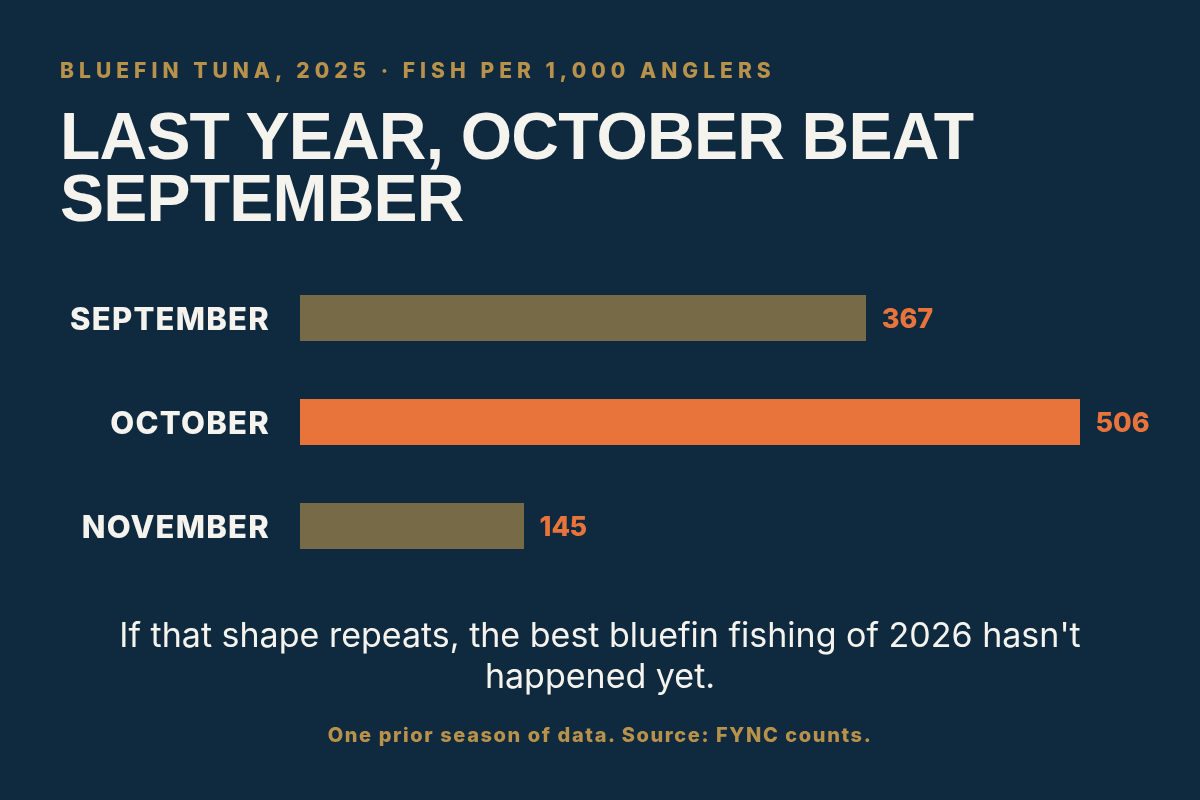
Bluefin: the one that historically gets better. This is the most defensible forward call in the whole forecast. Last year bluefin didn't peak in September — they peaked in October, at 506 fish per thousand anglers against September's 367. They held strong through the month and didn't collapse until November. If that shape repeats, the best bluefin fishing of 2026 hasn't happened yet. That's where I'd put an overnight.
Dorado: fading, but not fast. Last year dorado actually ticked up slightly from September to October before disappearing in November. Given how much stronger this season has been, September and October dorado should be a real presence rather than a curiosity.
Yellowtail: watch October. Last year yellowtail nearly tripled from September to October — 67 to 179 per thousand. Of everything on the board, this is the species most likely to surprise you late.
The inshore bite doesn't fade — it inverts
This is the part most forecasts miss, and it's the most useful thing here if you fish inside.
As the offshore species wind down, the bottom fishing gets better. Our rockfish rate climbed steadily last fall: 2,402 per thousand anglers in September, 3,194 in October, 3,894 in November. Whitefish did the same, running from 748 up to 1,242 by November.
Meanwhile the summer inshore species fall off a cliff. Sand bass dropped from 810 per thousand in July 2025 to 46 by September — a seventeen-fold collapse in two months. Calico bass tapered through the same window.
Practical version: if you're fishing inside this fall, stop chasing sand bass and start booking 3/4-day rockfish trips. The northern landings are already showing it — Hook's, Stardust, Morro Bay and Pierpoint are all running double-digit fish per angler right now.
The wildcard, and it's a big one
Here's what makes the back half of this season genuinely hard to call.
If NOAA is right that El Niño's West Coast impact arrives this fall and winter — and that Southern California feels the oceanic pathway hardest — then the warm water that pulled everything north early is about to be reinforced rather than relieved. Normally the offshore season closes because the water cools. This year the cooling may not come on schedule.
That argues for an extended season rather than an early one, and it's the opposite of what "the fish came early, so they'll leave early" would suggest.
There's precedent for how strange it can get. During the extended warm period from 2014 to 2018, scientists documented 36 unusual species off California — fourteen of them, including wahoo, recorded in the California Current for the first time ever. We've already had a wahoo on our counts this year, along with striped marlin, mako sharks, and a single shortbill spearfish landed at Seaforth on August 29 — the only one in our entire database.
What to book
If you want tuna: go now, and go long. Overnight and 1.5-day trips out of San Diego. The yellowfin window is narrowing even if it isn't closing, and the bluefin case for October means a trip booked for late September or early October may land better than one this weekend.
If you want a sure thing: bonito on a half-day. They're thick, they're everywhere from Dana Point to Ventura, and they don't require you to clear a weekend.
If you fish inside: start moving toward rockfish. The 3/4-day trips out of the northern landings are about to be the best value on the board and will stay that way into December.
If you want something strange: the exotics are a lottery ticket, not a plan. But this is the year to buy one.
What would prove this wrong
A forecast you can't be wrong about isn't a forecast, so here's what I'm actually claiming and what would falsify it.
If bluefin fall off through September rather than building into October, the seasonal read is wrong. If yellowfin rebound above August's rate, the early-arrival theory is wrong. And if the water cools on the normal schedule despite NOAA's outlook, the extended-season case collapses.
I'll tell you which way it went in the October forecast.
Plan your trip
See what's biting and where on our live fish counts, updated nightly across 21 sources, and compare every trip in the SoCal fleet on the trips page.
Tight lines — and go find your next catch.