
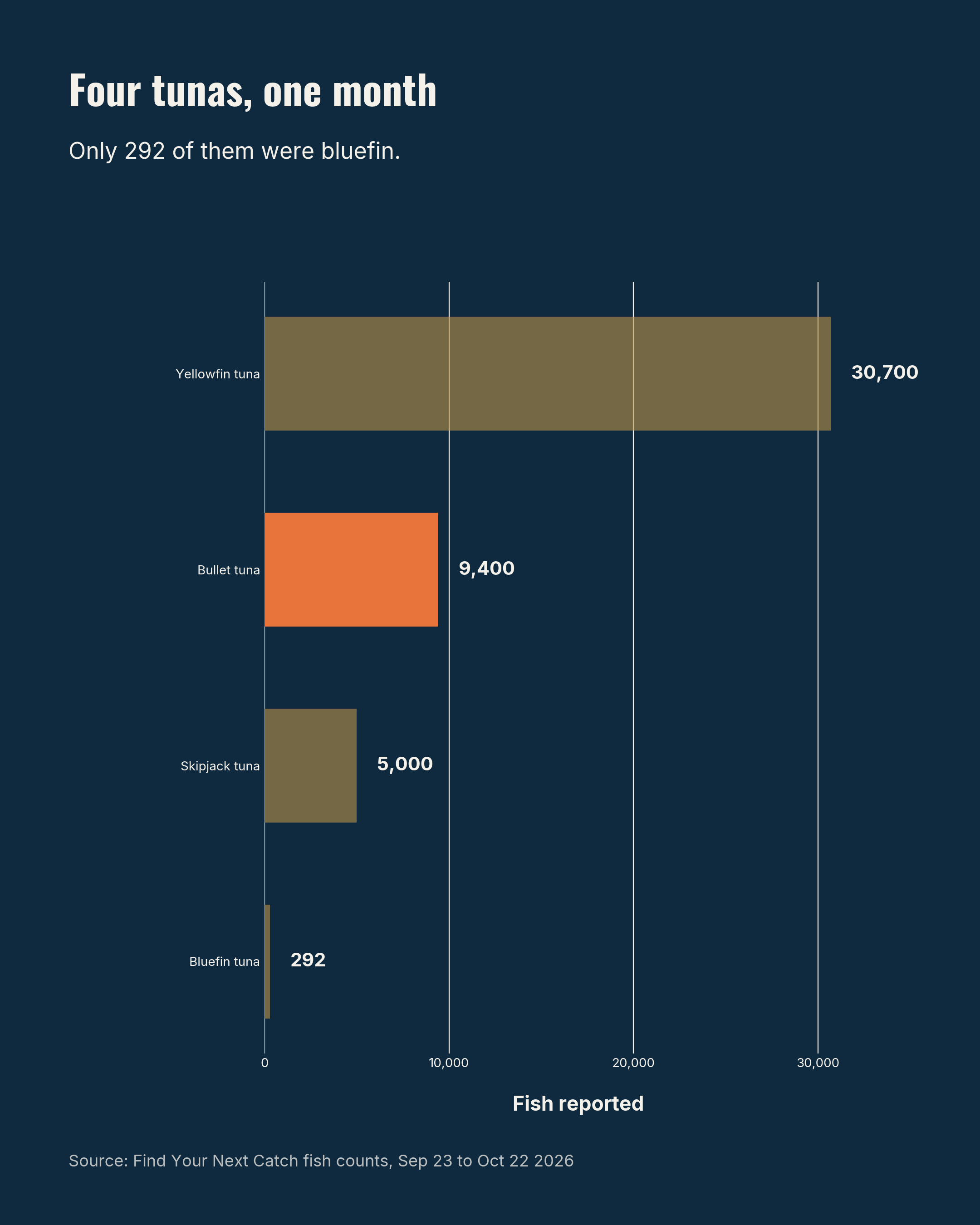
Over the last thirty days the Southern California fleet put about 45,400 tuna on the deck. Two hundred and ninety-two of them were bluefin.
That is six-tenths of one percent, in a region where "tuna trip" has meant bluefin for most of the last decade. The bluefin bite stopped on September 12 and has not come back. What filled the gap is four species, and two of them are fish a lot of anglers have never identified, never kept, and would not recognize in a photo.
One of them is currently the sixth most-landed fish in all of Southern California.
What's actually being caught
| Species | Last 30 days | Per angler | Landing-days |
|---|---|---|---|
| Yellowfin tuna | 30,700 | 1.34 | 204 |
| Bullet tuna | 9,400 | 0.58 | 135 |
| Skipjack tuna | 5,000 | 0.25 | 175 |
| Bluefin tuna | 292 | 0.05 | 49 |
Numbers from our own fish counts, pulled nightly from 19 SoCal landings.
Two things stand out. Bullet tuna has outproduced yellowtail, barracuda and dorado over the last month. And albacore has not shown up in the counts at all, with a single bigeye on one day, which for a SoCal fall is its own story.
Yellowfin tuna: the one everyone's catching
What it looks like. Metallic dark blue back, silver belly, and a yellow stripe running down the side. The giveaway is the row of bright yellow finlets between the second dorsal and the tail, each tipped in black. On bigger fish the second dorsal and anal fins stretch back into long sickles. School-size fish in our counts right now are mostly in the 15 to 40 pound range.
How they're being caught. Most of the yellowfin in these counts are coming on flylined sardines on 25 to 40 pound fluorocarbon, with a size 2 to 1/0 hook buried so the bait swims naturally. When the school is up and chewing, surface iron and poppers work. When they go down, a heavy jig or a sinker rig gets below them. The boats doing best on yellowfin right now are running out of San Diego and Orange County on full-day and 1.5-day trips.
How to cook it. This is the one you build a meal around. The loins are firm and mild enough for sashimi if you bleed and ice the fish immediately. Poke, seared rare with sesame, or straight on the grill at high heat for ninety seconds a side and no longer. Yellowfin dries out faster than people expect, so pull it while the center is still red.
Bullet tuna: the fish nobody knows they're catching
What it looks like. Small, usually under 20 inches and a couple of pounds. A dark blue-black back with wavy, oblique markings across the rear half of the upper body, and a scaleless belly below a well-defined corselet of scales around the shoulder. The two dorsal fins are set noticeably far apart, which is the quickest way to separate it from a small bonito or a mackerel. A lot of people call it a bullet mackerel.
How they're being caught. Mostly by accident. Bullet tuna show up in the same offshore water as yellowfin, and they hit small flylined baits and small surface iron meant for something bigger. If you are getting hammered by fast, small fish on the outside, that is often what this is. Nobody in Southern California targets them on purpose, which is part of why 9,400 of them turned up in the counts without anyone writing about it.
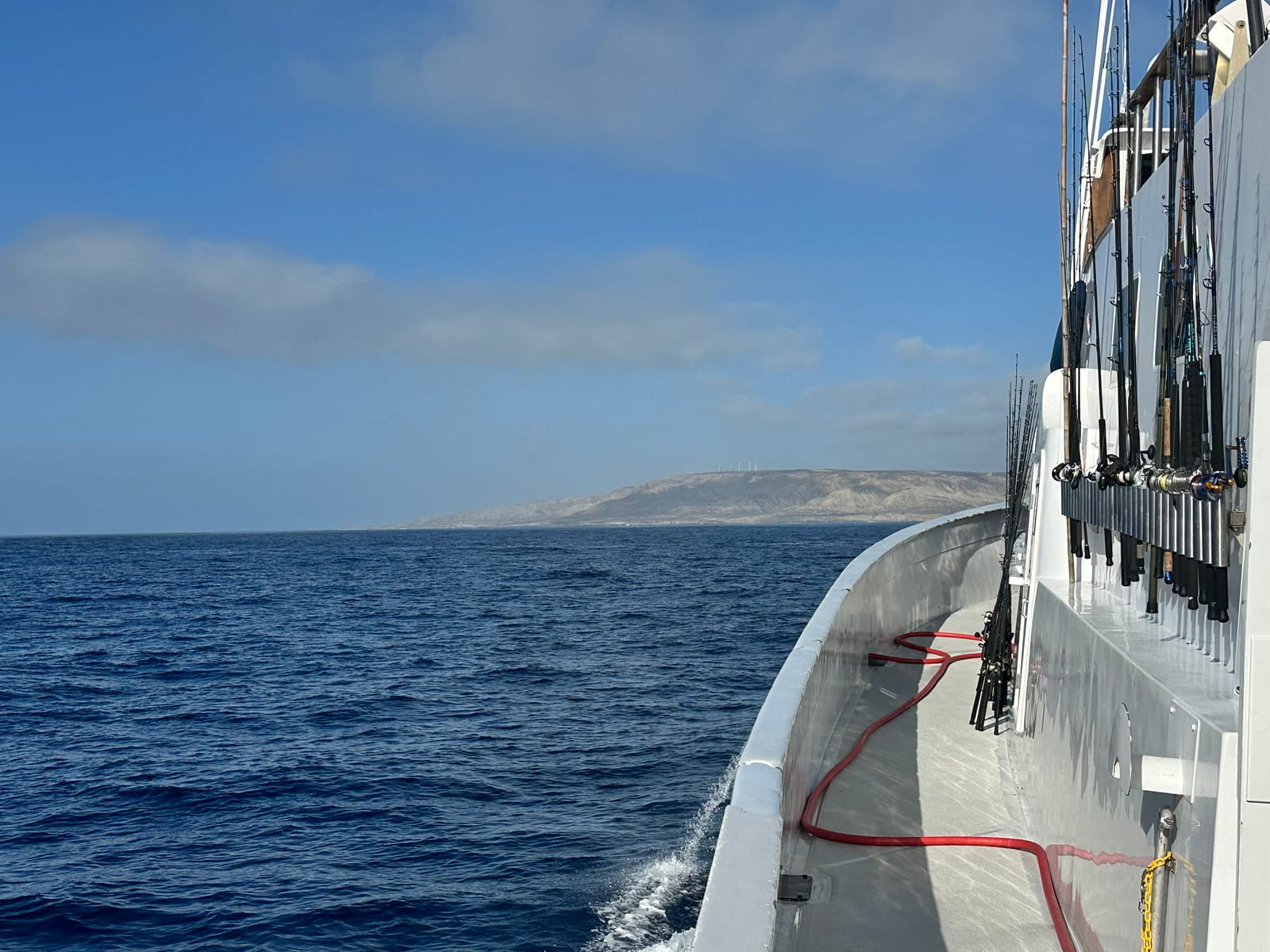
I was on a 1.5 day out of 22nd Street last week that went looking for yellowfin and never found them. What the yellowfin grounds gave up instead was bullet tuna.
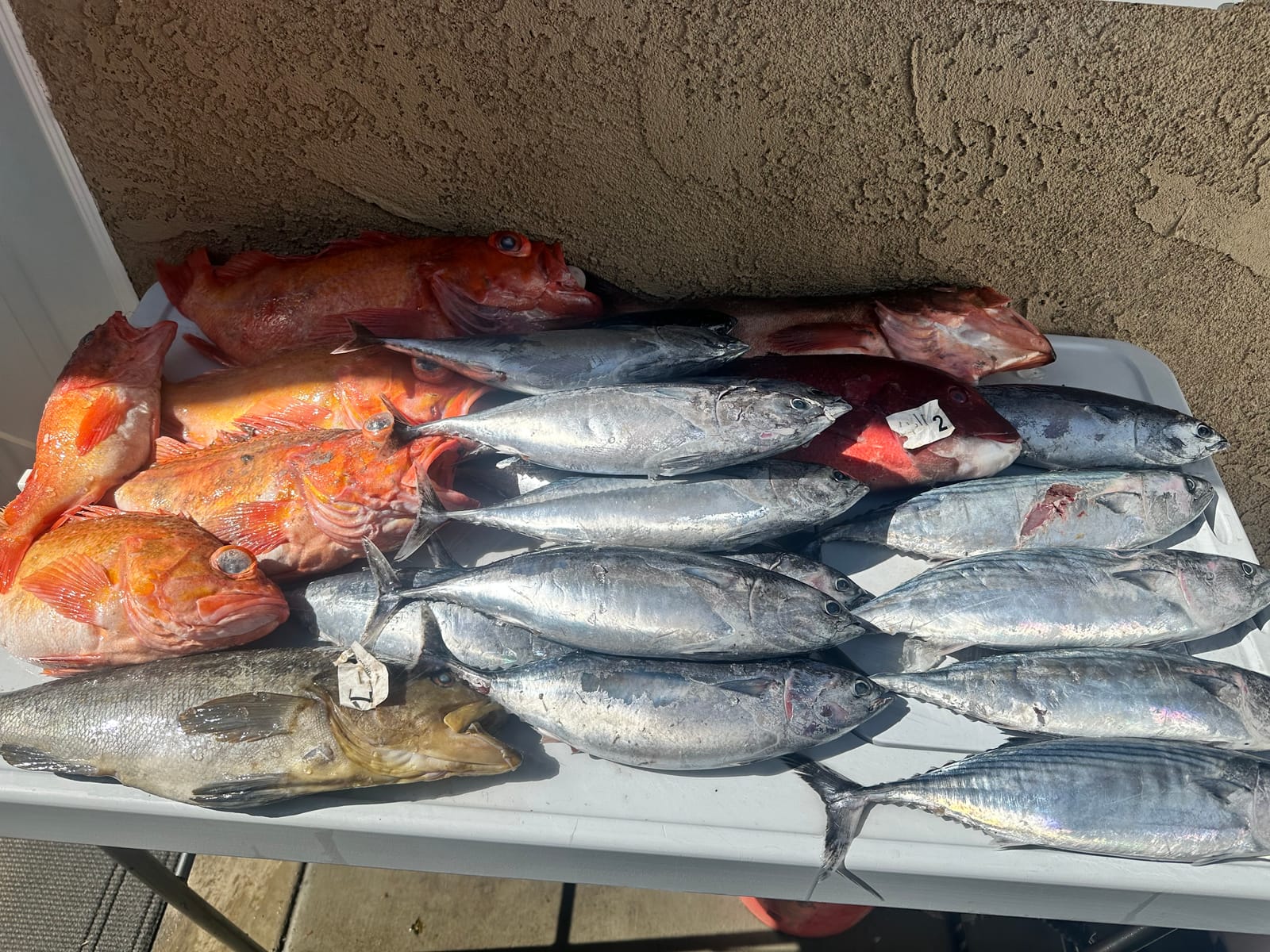
How to cook it. Honestly: this is the weakest eating of the four, and plenty of anglers use them for bait with a clear conscience. The meat is dark, soft and strong, and it does not hold up to a hot grill. If you want to eat one, the Mediterranean approach is the right one. Confit the loins slowly in olive oil with garlic and a bay leaf, let them cool in the oil, then flake them into a salad or onto bread. Smoking works too. What does not work is treating it like yellowfin.
Skipjack tuna: better than its reputation
What it looks like. The easiest ID in the family. Four to six dark horizontal stripes run along the belly and lower sides, not the back. Nothing else out there is marked that way. The back is dark purple-blue, the body is torpedo-shaped and scaleless except for the corselet. Most of what the fleet is catching runs 4 to 12 pounds.
How they're being caught. Same water and often the same cast as the yellowfin. Skipjack are faster to the bait and less selective, which is exactly why so many people consider them a nuisance: they eat the sardine the yellowfin was coming for. Lighter fluorocarbon and a smaller bait will get you more of them if you want them.
How to cook it. Here is the thing most people don't know. Katsuobushi, the smoked and dried fish that Japanese dashi is built on, is skipjack. Those "bonito flakes" in every ramen recipe are this exact fish. It is the backbone of an entire cuisine and most SoCal anglers put it in the bait tank.
Treated right it is genuinely good. Bleed it the second it comes over the rail, ice it immediately, and cut the dark bloodline out aggressively when you fillet. Then sear it rare like tataki, slice it thin and hit it with ponzu and grated ginger. Or make poke with it. Skipjack is also the lowest-mercury tuna of the group, which matters if you are feeding it to kids.
What it is not good for is sitting in a kill bag in the sun and then going on a grill well-done. That is how it earned its reputation.
Bluefin tuna: the ghost
What it looks like. Deepest body of the four, dark metallic blue above and silver-white below, with short pectoral fins that do not reach past the midpoint of the body. That short pectoral is the quickest tell against a yellowfin of the same size.
How they're being caught. Barely. 292 fish across the entire fleet in thirty days, on 49 landing-days. The bite fell off a cliff on September 12 and has not recovered. I wrote about that when it happened and I called a recovery for October that did not arrive.
How to cook it. If you get one, it is the best eating fish in this article and it is not close. High fat content, especially in the belly. Sashimi, or seared hard on the outside and left raw in the middle. Do not overthink it and do not overcook it.
The part that actually matters: handling
Everything above about flavor depends on one thing, and it is not the species.
Tuna family fish build up histamine fast when they are not chilled quickly. That is what causes scombroid poisoning, and it is worth knowing about because cooking does not destroy it. A fish that sat warm too long can make you sick no matter how you prepare it. Symptoms turn up within an hour or two and look like an allergic reaction: flushing, headache, a peppery taste.
This is specific to this family, which is exactly why handling gets talked about more with tuna, bonito and mackerel than with rockfish.
The handling itself is simple and the boats already know it:
Bleed it immediately. Cut the gills or the arteries behind the pectoral fin the moment it comes over the rail.
Ice it immediately. Not after the bite slows down. Into the kill bag with plenty of ice, right away.
Cut the bloodline out. The dark red strip down the center of the fillet is where most of the strong flavor lives. On skipjack and bullet tuna especially, take all of it.
Do those three things and a skipjack eats well. Skip them and a yellowfin doesn't.
What to book
The yellowfin bite is still the best offshore story in Southern California, and that window is closing rather than opening. If you want a tuna trip this year, the next two or three weeks are it. Full-day and 1.5-day trips out of San Diego and Orange County are where those counts are coming from.
And if you go, keep the skipjack. You'll be the only one on the boat who does.
You can see the same counts I used at findyournextcatch.com/intel, filter by species, and book from what you see at /trips.