Anyone who fishes seriously knows the feeling. Not the relaxation that non-anglers assume the sport is about — the focus. The way everything else falls away the moment a bait hits the water. The strange, satisfying quiet of standing on a deck before sunrise, watching the horizon, waiting for something to happen.
It's not a hobby. Hobbies don't pull you out of bed at 3 AM. Hobbies don't make you drive two hours to a harbor in the dark. Hobbies don't have you scanning weather forecasts and fish counts at midnight on a Tuesday. There's something else going on, and it's worth asking what.
A Theory Worth Sitting With
In Chasing Antelopes, Dr. Robin Willcourt explores a question that's been knocking around evolutionary biology for decades: how did human brains grow so fast, so dramatically, in such a short window of evolutionary time? The standard answer used to be hunting big game on the savanna — chasing antelope across grasslands, the cooperation and pattern-recognition required for the chase driving cognitive growth.
But Willcourt and others have argued that the real fuel may have been somewhere else: the water. When early humans in East Africa moved toward coastlines, lakes, and rivers, they tapped into a source of nutrition denser and more brain-friendly than anything available on land. Fish and shellfish are loaded with omega-3 fatty acids, particularly DHA — the building block of neural tissue. The theory holds that as our ancestors started reliably harvesting protein from the water, the raw material for brain development became abundant in a way it had never been before.
I want to be clear that this is one theory, and it's debated. The expansion of the human brain was almost certainly driven by a tangle of factors, not a single cause. But the idea that fishing — the act of reading water, tracking patterns, adapting to tides and seasons — was woven into the moment our species started becoming what we are now? That's hard to shake.
What Fishing Actually Is
Strip away the modern packaging and consider what's actually happening when you fish.
You're reading the environment. Water clarity, temperature breaks, current edges, bird activity, surface disturbance. You're processing signals most people would never notice. You're holding multiple variables in your head — tide stage, time of day, wind direction, bait presence — and updating your model of where fish should be in real time.
You're making decisions under uncertainty. There is no certainty in fishing. Every cast is a probability bet against incomplete information. You commit to a spot, a depth, a presentation, knowing it might be wrong, knowing the only way to find out is to try.
You're exercising patience and timing simultaneously. Most of fishing is waiting. Most of catching is acting fast when the moment arrives. The two skills look opposed but they're the same skill — staying engaged through a long blank stretch so you're ready when something finally bites.
This is, mechanically, the same kind of cognitive work our ancestors were doing on a beach in East Africa two hundred thousand years ago. The tools changed. The brain didn't.
The Quiet That Isn't Quiet
My dad got me into this. Years ago, he took me out of San Francisco on a salmon charter — the trip that hooked me on deep sea fishing in the first place. We've only fished together that one time, but it was enough. It put a thing in me that I've been chasing ever since.
What he really gave me, more than the fishing itself, was a respect for the ocean and the people who embody it. The captains, the deckhands, the boats, the whole industry that exists to put anglers on fish. He taught me to take it seriously — not solemnly, but as something that deserves your attention and care because it's bigger than you are. That's stuck with me harder than any single trip ever could.
My fishing passion got carried forward with friends. The ones who'd text me at 8 PM on a Friday — "be at the dock by 5am, boat takes off at 6." — and I'd say yes before checking what kind of trip it was. Years of overnights, full days, half days. Different boats out of different landings, different crews, different bites. Each trip taught me something — something about the water, the fish, the rhythm of how it all works. Each one humbled me. Each one deepened my love for the ocean and those respect it.
But the thing I'm trying to describe in this post — the focus, the way fishing pulls everything else out of your head — I've felt it a hundred times now. Standing on the rail, watching the rods, the quiet, the boat rocking, the sun coming up, the adrenaline when you're bit and you see fish coming over the rail. The stoke. The kind of attention you can't manufacture in a restaurant or on a phone call.
That's the part you can't sell to non-anglers. They think you're going fishing to relax. You're not. You're going fishing because it's one of the last activities left that demands enough of you, mentally and physically, that everything else has to step aside while you do it. The quiet isn't quiet — it's a different kind of attention. Sharper. Older. The kind your brain was actually built for.
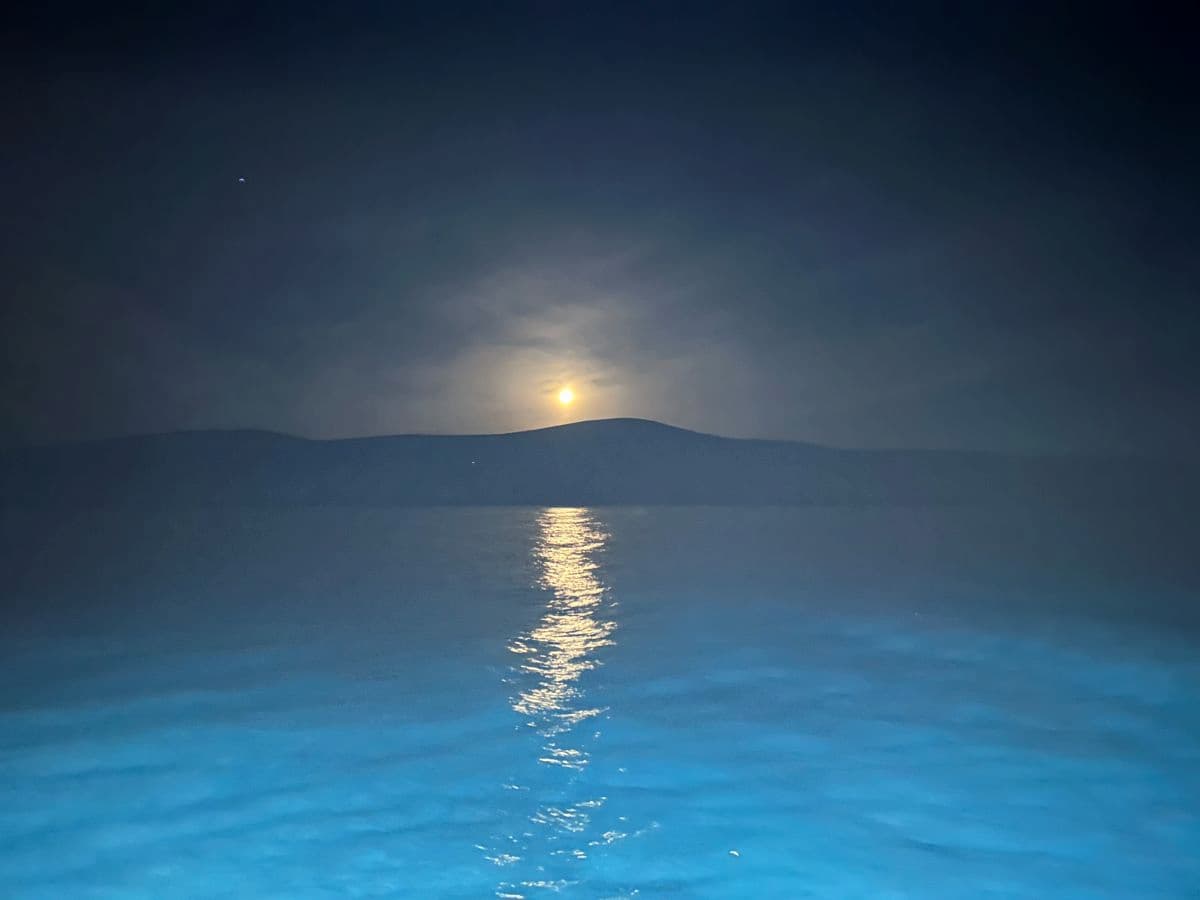
Modern life is mostly designed to fragment your focus. Notifications, infinite feeds, ten tabs open, three conversations going at once. Fishing is the opposite. You can't multitask offshore. You can't half-pay-attention to a 60-pound bluefin on the line. The water demands all of you. And when it does, the people on the deck around you — fathers, friends, strangers — get pulled into it too.
Offshore Is Where It Sharpens
Inshore fishing is real fishing — calicos, sand bass, halibut, the whole nearshore game has its own depth and its own challenges. But there's something about offshore that turns the dial up another click.
You're out of sight of land. The scale shifts. The water below you is hundreds or thousands of feet deep. The fish you're chasing — bluefin, yellowfin, dorado, yellowtail — are bigger, faster, and don't give themselves up easily. The variables multiply. Water temperature breaks become decisive. Bird schools become signals. The captain's read on where the fish are moving determines whether the trip is a success or a long ride to nothing.
And the teamwork on a sport boat offshore is something else entirely. Twenty strangers on a deck at 4 AM, bait flying, a captain calling spots, deckhands working the gear, anglers cooperating to land fish without crossing lines. It's the closest most modern people will ever come to the kind of coordinated group hunting our species evolved to do.
I'm not saying you should book a 1.5-day to feel ancient. I'm saying that if you've ever wondered why a tuna trip stays with you for weeks afterward in a way that a day at the beach doesn't — there's a reason. You weren't relaxing. You were doing the thing your nervous system was built for. If that's the trip you're chasing, overnight and 1.5-day offshore runs are listed across every major SoCal landing on FYNC, with current fish counts and departure conditions for each.
Bringing It Home
There's another thread to all this that I've been dancing around. The reason our ancestors fished wasn't to find their focus or commune with the ocean. They fished because they needed to eat.
That part hasn't gone away, even if most modern anglers don't think about it directly. Some of the deepest satisfaction I get from fishing has nothing to do with the trip itself — it's after, in my kitchen, breaking down a fish I personally caught and putting dinner together for people I love.
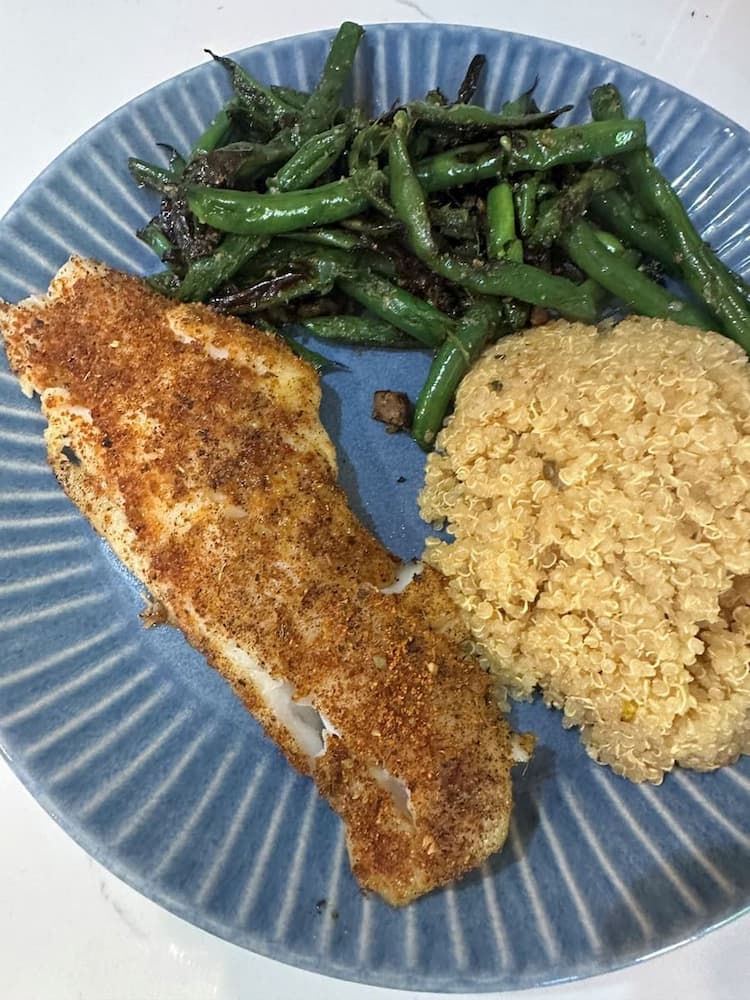
There's a moment in cooking your own catch that I don't think anything else in modern life replicates. You stood on a deck. You watched the rod go off. You fought the fish, brought it over the rail, iced it down, drove it home. You filleted it yourself, or watched a deckhand do it for you. And now it's on a cutting board, and you're deciding how it's going to be served. Pan-seared, simmered into a stew, raw on rice with a little soy and yuzu — whatever it is, it's a chain of choices that started the moment you picked the trip.
Tell that story over dinner. Watch what happens. Most modern food has no story. It has a barcode and a sell-by date. A fish you caught carries the whole arc — the conditions that morning, the spot the captain picked, the moment the line went tight, the people who were there with you. You're not just feeding someone. You're handing them an experience compressed into a meal.
That's not nothing. That might actually be most of it.
The Modern Mismatch
Here's where it gets interesting, and where my own work comes in.
Fishing is one of the oldest skills humans have. But the way most of us book fishing trips is broken. You pick a landing because you've heard of it. You pick a date because it's the weekend you have free. You show up and find out the bite was three days ago, or the boat went to a spot that wasn't fishy, or you booked a half day when you really wanted a full day.
The information is out there. Fish counts are published daily. Weather and water temp data are public. Charter schedules are visible if you know where to look. But it's spread across a dozen websites, written for insiders, and the average angler — even an experienced one — has to do an hour of research across multiple tabs to make a smart decision about which trip to book.
Find Your Next Catch is here to solve that problem. One place to compare trips across all 21 SoCal landings, see what's biting right now, check conditions, and book the trip that fits what you actually want to do. Browse current trips or check this week's hot boats — both are free. Not because anglers are bad at picking trips — they're not. Because the tools available to most of us haven't caught up to how good the information could be.
The Closing Thought
If the theory is right — if part of what made us human came from learning to read water and pull food from it — then fishing isn't a leisure activity. It's a return. Every time you stand on a deck at sunrise and lock in on the horizon, you're doing the thing that helped shape the brain that's letting you read this sentence.
That's worth taking seriously. Worth giving real time to. Worth doing well. And worth approaching with the kind of respect my dad first taught me — for the ocean, for the people who work it, for the fish themselves. The pull is older than us, and it'll outlast us. The least we can do is meet it with attention.
My dad helped me write this one. He's not a fisherman the way I am, but he started me on this path and gave me the framework I still use to think about it. Which is maybe the point: the pull is bigger than the sport. Sometimes it just takes one trip with the right person to feel it.
If you haven't been on the water in a while — or ever — let this be the nudge. Find a trip near you, or sign up for the weekly bite report and let us tell you when the conditions look right. The ocean is a more accessible thing than people think. You just need to pick a trip and show up.
Tight lines. Go find the bite.