
446 pounds on the scale, gilled and gutted.
That's the hard number on the bluefin Markus Medak brought into Point Loma this week aboard the F/V Shearwater. You'll see it reported as 504, and that figure is honest too — it's just a different thing. More on that in a second.
What matters more than either number is how it came aboard. Daytime. Rod and reel. A heavy jig. A long, hard fight. Not a net, not an overnight set — a fish hooked and fought the way anyone reading this would recognize.
446 or 504?
Both, depending on what you're measuring.
Bluefin are weighed dressed — gills and guts out — because that's how they're handled at the dock. This one went 446. To estimate the whole fish, the fleet adds roughly 13 percent back:
446 × 0.13 = 58 446 + 58 = 504 pounds whole
That's the standard conversion, not a guess pulled from the air. But it's still an estimate — the fish was never weighed intact, so 504 is arithmetic, not a scale reading. The measured number is 446.
Worth knowing which is which, because you'll see both quoted as though they're the same kind of fact. They aren't.
Many people in San Diego are calling it the largest bluefin ever caught on rod and reel in California. That's a claim worth taking seriously from the people making it — they'd know — though it isn't something a record book will ever settle, for reasons below.
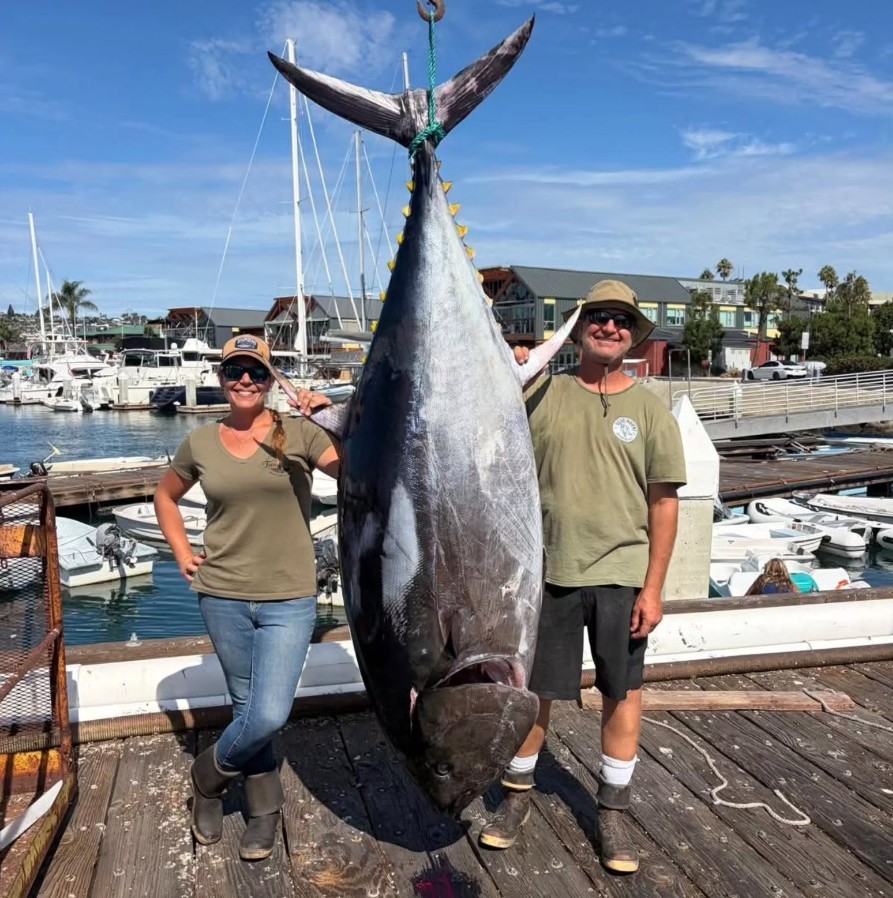 Photo courtesy of Tommy Gomes, Tunaville Market and Grocery
It won't be a state record, and that takes nothing from it
California state records are reserved for sport-caught fish. This one was landed on a commercial trip, so it doesn't go in the book.
That's a category rule, not a judgment. The current state record stands at 395 pounds 6 ounces from Tanner Bank in 2021 — and Tommy Gomes put it plainly: had Medak been out sportfishing, this would have been the new one.
The fish is no less real for not having a plaque.
Who caught it
Medak isn't a stranger to a scale. He runs the New Lo-An, and he's one of three captains — alongside Justin Fleck of the Excel and Drew Card of the Pacific Queen — who took over Five Star Fish Processing from the Saraspe family about a decade ago. Five Star has been handling fish for San Diego's sportfishing fleet since 2003, meeting the long-range boats at the dock when they come in.
The man who caught this fish spends most of his working life around other people's.
Where it went
This is the part worth pausing on.
The fish went to Tommy Gomes at Tunaville Market and Grocery, and from there to Herb & Wood, where it was broken down Thursday night at a dinner with the fish as the guest of honor. Open to the public, reservations suggested.
Caught by a San Diego captain, handled by a San Diego fishmonger, served in a San Diego dining room. A fish that size used to mean a photograph and a freezer. This one became a meal, and never left the county doing it.
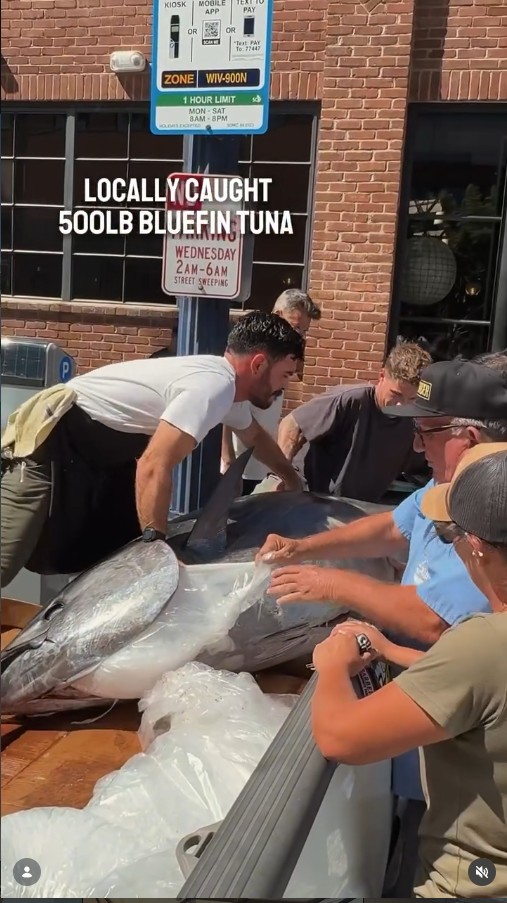 Photo courtesy of Tommy Gomes, Tunaville Market and Grocery
Gomes has spent his career arguing that locally caught fish should stay local. This was that argument, made at 446 pounds.
Why a fish this size exists at all
Here's the part that should make you optimistic rather than just impressed.
Pacific bluefin were in real trouble a decade ago — overfished, grim assessments, the kind of situation where people start using the word collapse. Then an International Scientific Committee assessment found the population had rebuilt roughly ten years ahead of schedule. The Inter-American Tropical Tuna Commission followed by raising U.S. commercial catch limits by nearly 80 percent for the 2025–2026 season.
California's own numbers say the same thing from the deck. CDFW logbooks from commercial passenger fishing vessels recorded 2,191 bluefin in 2019. By 2023 it was 52,405 — twenty-five times as many in four years.
That's the context. A 504-pound fish isn't a freak event; it's what happens when enough fish are left alone long enough to get old. Fish that size exist because the ones before them were allowed to.
The part nobody's mentioning
Here's the detail I keep coming back to, and it's buried in Herb & Wood's own post about the dinner: the head is going to a scientist.
Specifically, to someone studying its otoliths — the small calcified structures in a fish's inner ear that lay down growth rings, the way a tree does. Read them and you get the animal's age, and traces of where it spent its life.
Pacific bluefin are born in the western Pacific, off Japan and Taiwan. A portion of each year class crosses the entire ocean to feed off California, and some cross back. Herb & Wood says this fish made that round trip. The otoliths are how that gets confirmed rather than assumed.
So the fish that shows up in every recovery statistic is about to become a data point with an actual number attached — an age, a migration record, a life. Most of the fish in those CDFW logbooks are just counts. This one gets read.
That's a better ending than a record book entry.
The bite behind the big fish
The giant is the headline. The fishing right now is what you can act on.
Over the last three days our counts show bluefin across seven landing-days, and the San Diego multi-day boats are the ones connecting. The Pacific Queen — Drew Card's boat, one of the same Five Star group — came back from a 3-day with 191 fish, 120 of them bluefin, on 20 anglers. The Islander landed 148 bluefin on 26. The Poseidon put up 124 on 23. The Pacifica did 80 on 22 on a 1.5-day.
Five to six fish per angler on the boats finding them. That's a real bite.
And in our September forecast we argued bluefin were the species most likely to improve into October rather than fade — last year they peaked in October, not September. Two weeks in, nothing has argued against it.
If you want one: 2-day and 3-day trips out of San Diego. Not overnights, not day trips. Our bluefin tactics guide covers the flat-fall program and the kite game if you've never chased them.
The thing worth celebrating
It would have been easy for a fish like this to become a number — weighed, photographed, argued about online, forgotten by the weekend.
Instead it got cut in public and eaten a few miles from where it came over the rail, by people who understood what they were looking at.
Bluefin are back off Southern California in a way almost nobody would have predicted ten years ago. This is what that looks like.
See what's biting and where on our live fish counts, updated nightly from 21 sources, and compare every trip in the SoCal fleet on the trips page.
Tight lines — and go find your next catch.